Single pile analysis — axial and lateral
Solve a single pile in layered soil, in your browser. The soil profile is entered once and feeds both analyses. Laterally, the pile is an elastic beam and the soil is a stack of nonlinear p-y springs. Axially, shaft friction and end bearing mobilise separately through t-z and Q-z curves. The pile-head spring constants for your 3D building model and the depth to fixity come out of the same analysis.
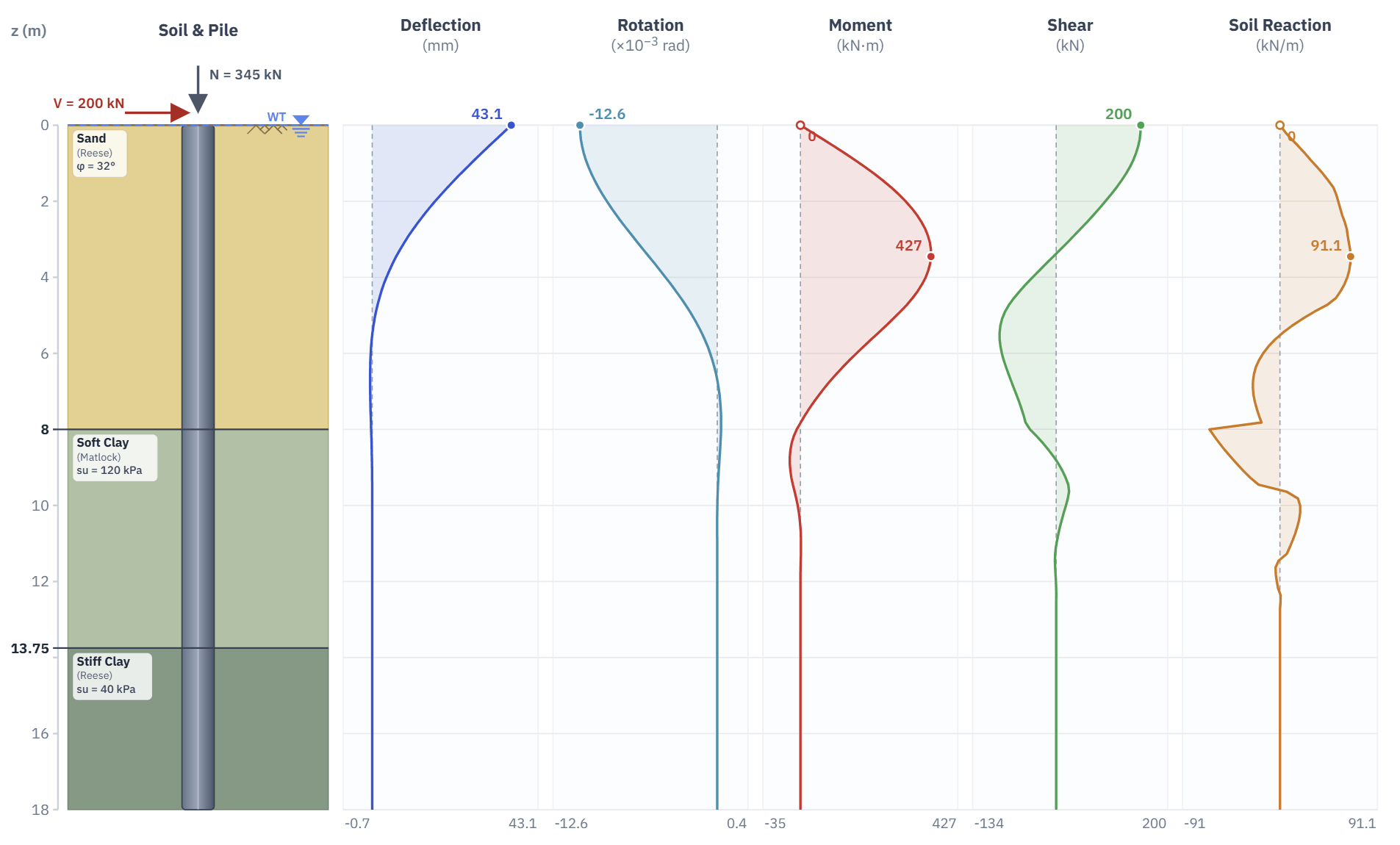
One soil profile, two analyses
You can stack soft clay, stiff clay, sand, linear stiffness and void (cavity) layers in any order; above or below the water table. The same profile drives both analyses, and the axial force profile from the axial run can be passed to the lateral analysis as the P-Delta input.
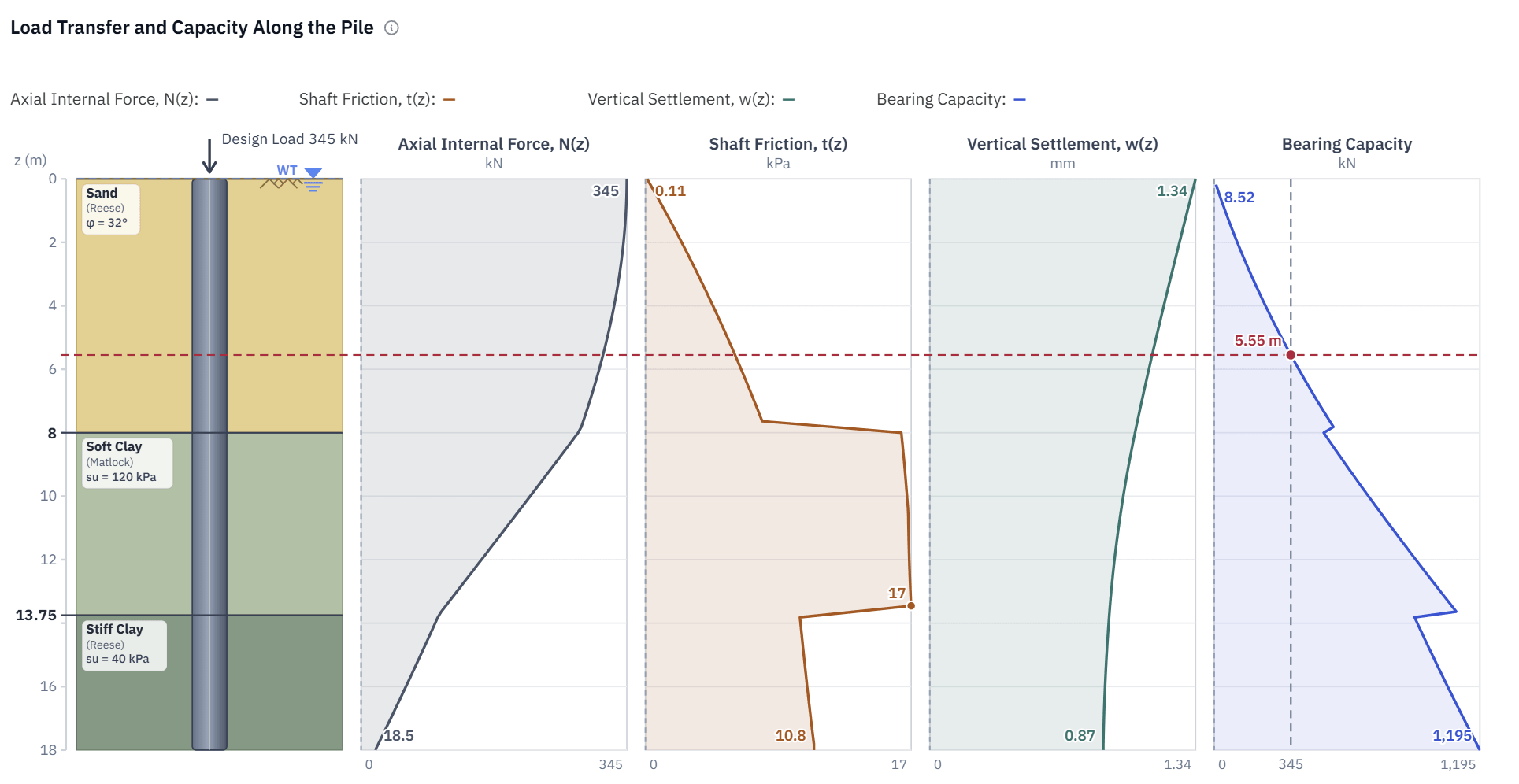
Deflection, moment and shear with depth
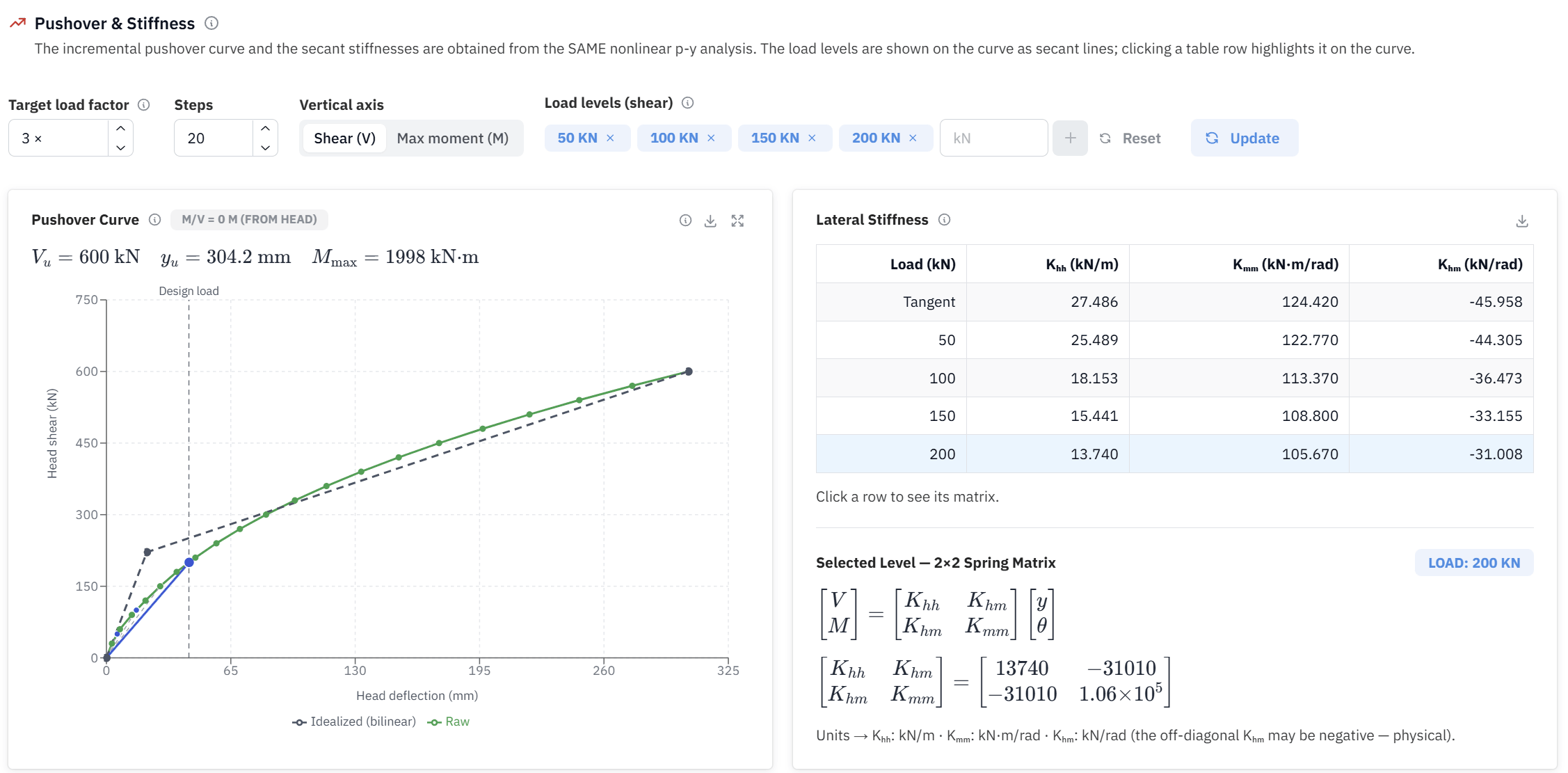
The lateral equation is built node by node using finite difference method and solved iteratively. Deflection, rotation, moment, shear and soil reactions are reported along the pile. Five pile-head boundary conditions are available, and a lateral pushover curve is produced alongside.
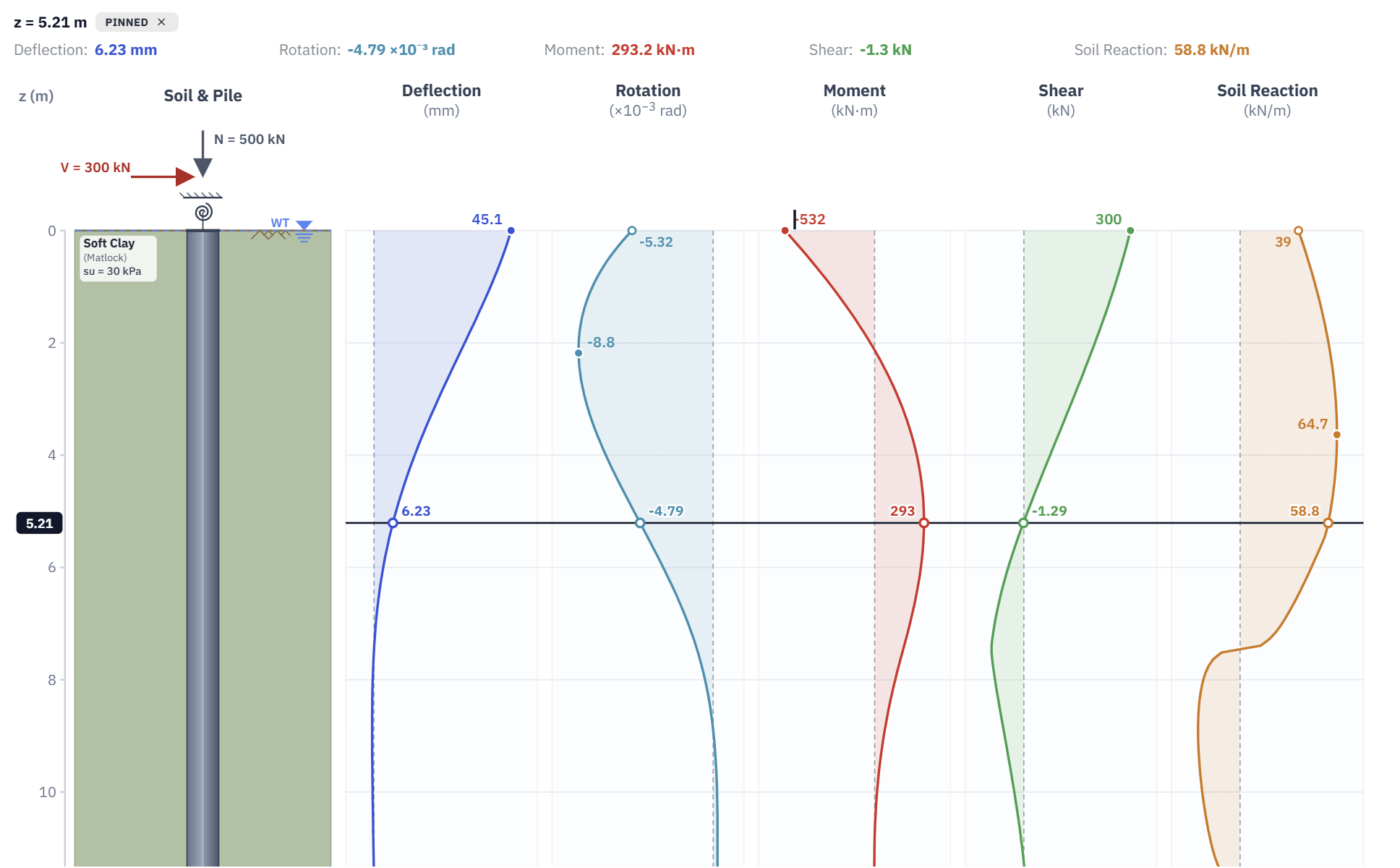
p-y curves and the equations behind them
Published behaviour models for soft clay, stiff clay and sand are implemented. Curves are drawn at the depths you pick, and each model's equations, coefficients and clause reference are shown inside the calculation.
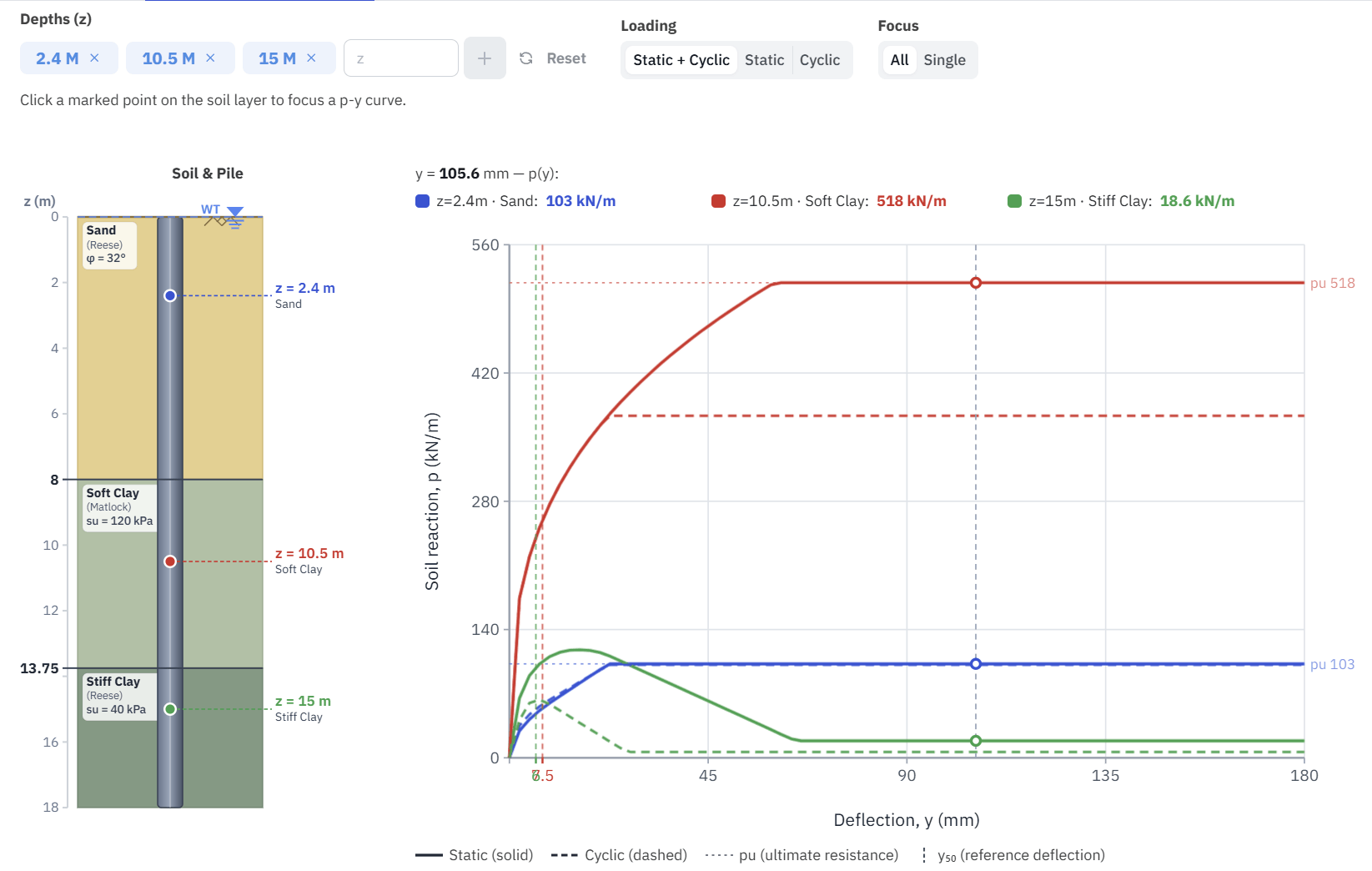
Axial capacity and settlement
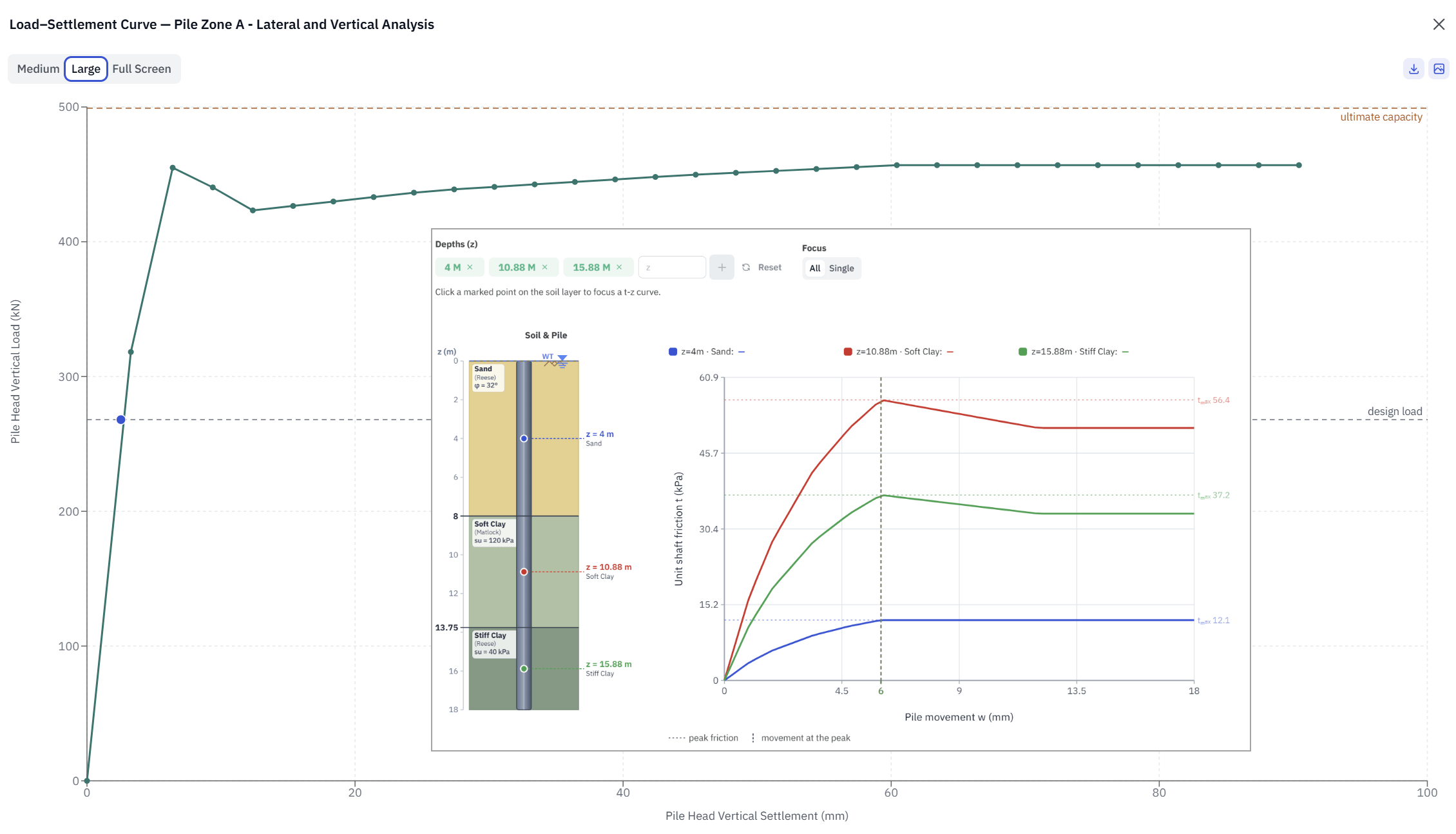
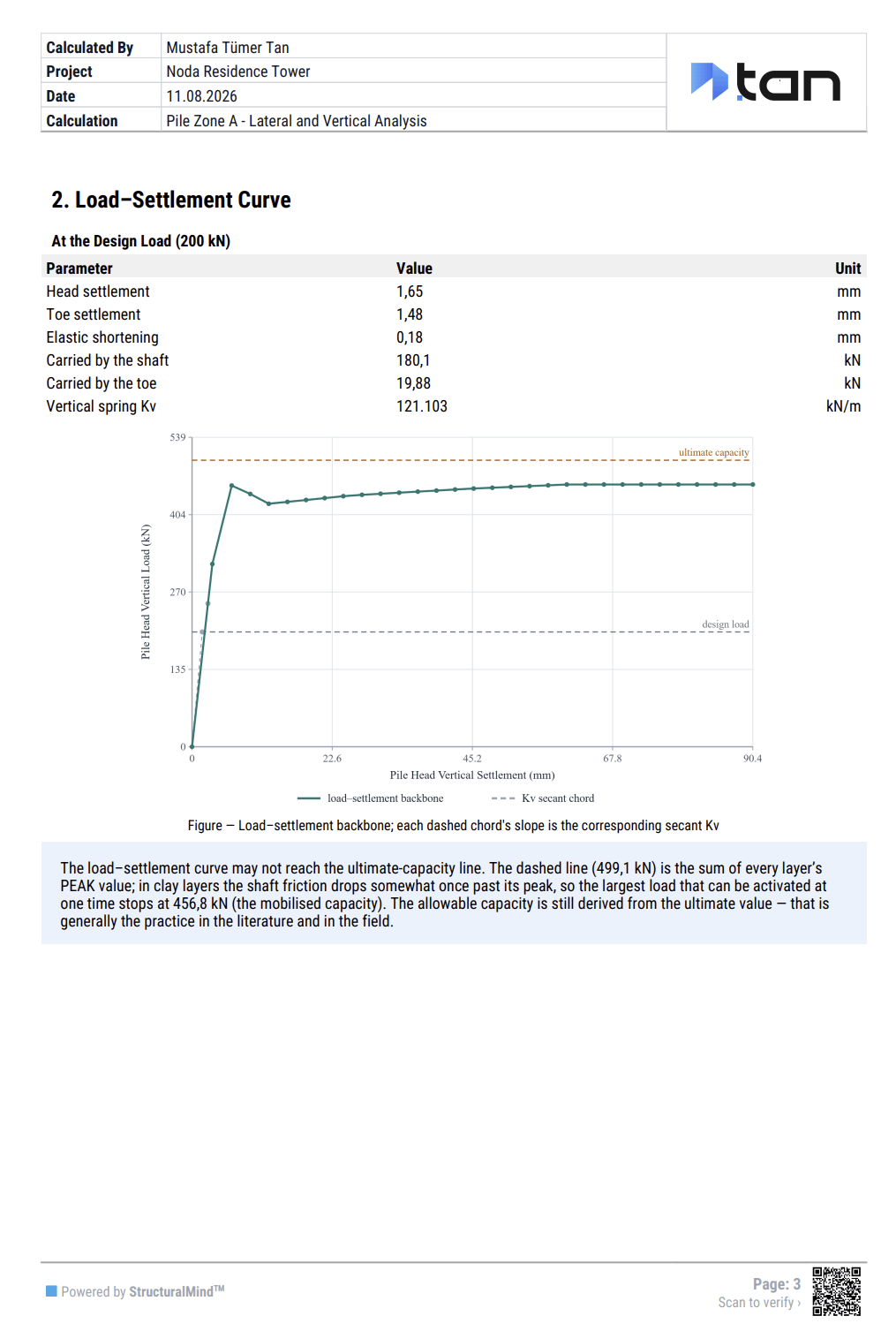
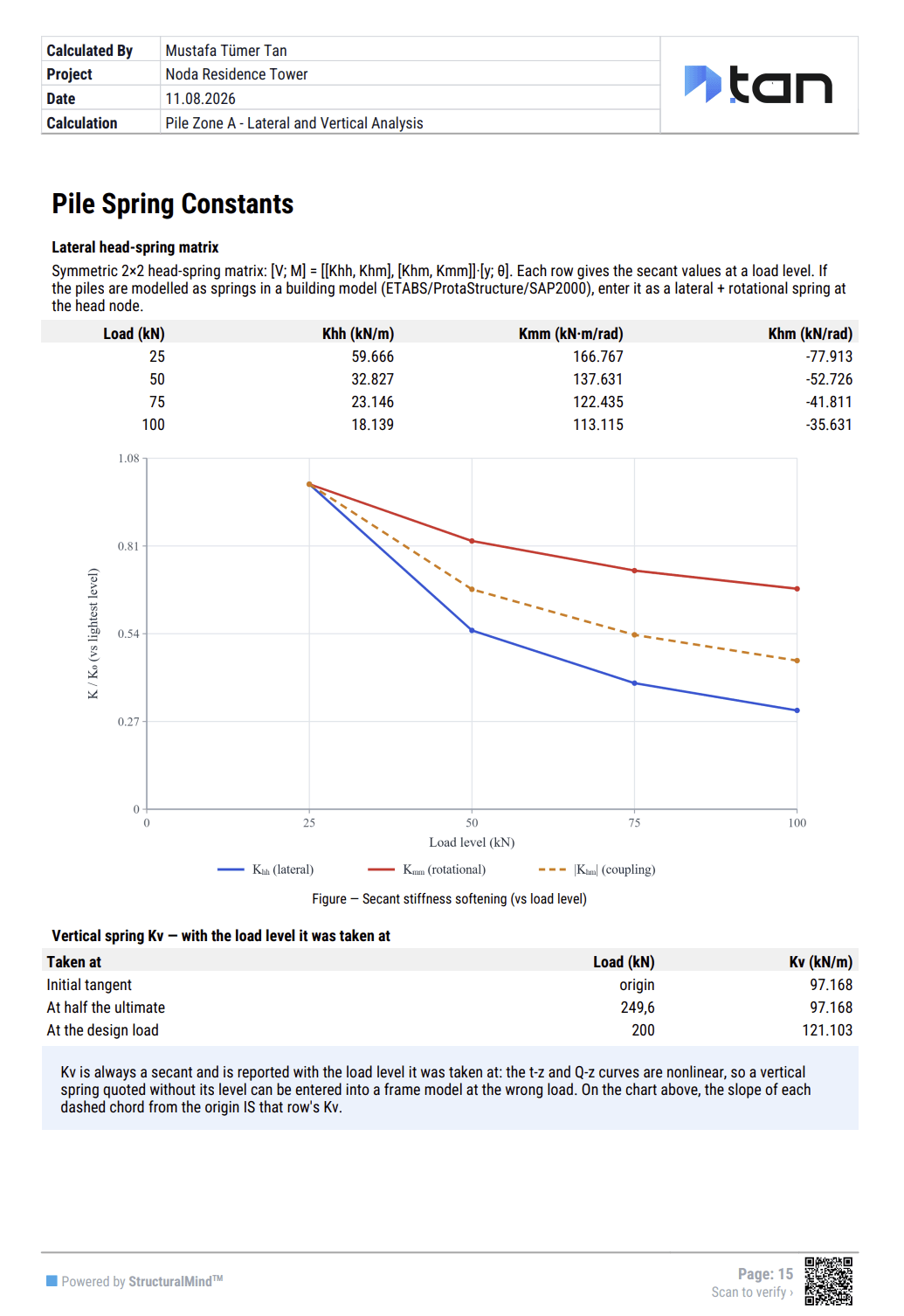
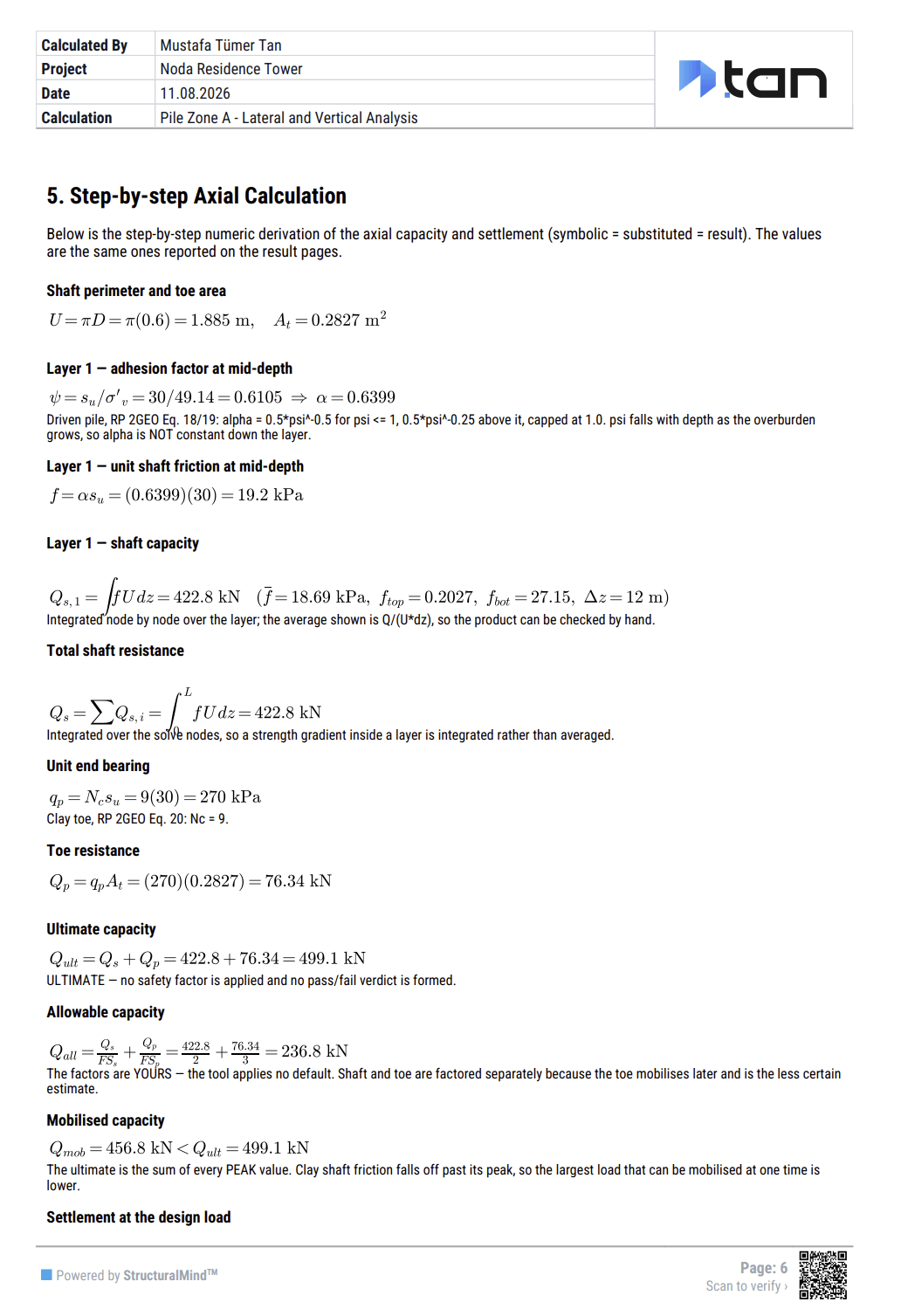
Shaft friction and end bearing are computed separately, with separate safety factors for shaft and toe. The load-settlement curve comes from sweeping toe displacement in a single pass. Elastic shortening is integrated rather than estimated, and the vertical spring is reported with the load level it was taken at.
Spring constants for your 3D building model, and depth to fixity
Lateral, rotational and cross-coupling pile-head springs are reported as secants at the load levels you mark on the pushover curve, together with the 2×2 spring matrix. Depth to fixity comes with three values: the Davisson & Robinson closed form, the observed depth read off the solved deflection curve, and the equivalent cantilever length.
Formula-referenced report, publishable calculation
Calculation steps, equations and their clause references appear in the interface and in the PDF report alike. A calculation can be published as an immutable copy and shared through a QR-coded verification link.
Questions
- Which p-y models are implemented?
- Matlock (1970) for soft clay, Reese, Cox & Koop (1975) for submerged stiff clay, Welch & Reese (1972) for stiff clay above the water table, Reese, Cox & Koop (1974) for sand and the API RP 2A calibration. Linear stiffness and void (cavity) layers can be defined as well. Equations are shown with their clause numbers from FHWA/RD-85/106.
- Can I take the pile-head springs into my structural model?
- Yes. Lateral, rotational, cross-coupling and vertical spring constants are computed at the pile head and can be entered into ETABS, SAP2000, ProtaStructure or a similar 3D building model. If you would rather represent the pile with an equivalent cantilever, the depth to fixity is given too. That value holds for long, flexible piles.
- What are the results checked against?
- Results are checked and verified against published field load tests and worked examples. The deviations measured on the Sabine River, Mustang Island and Houston lateral load tests, on the GEC 10 and O'Neill & Reese worked examples and on two axial load tests are published on the verification page.
- Is this calculation free?
- Single Pile — Axial and Lateral Analysis is a premium calculation included in the Engineer plan. You can try it free.
Start calculating in minutes.
Sign up, pick a calculation, and produce your first auditable report.