Pile group analysis
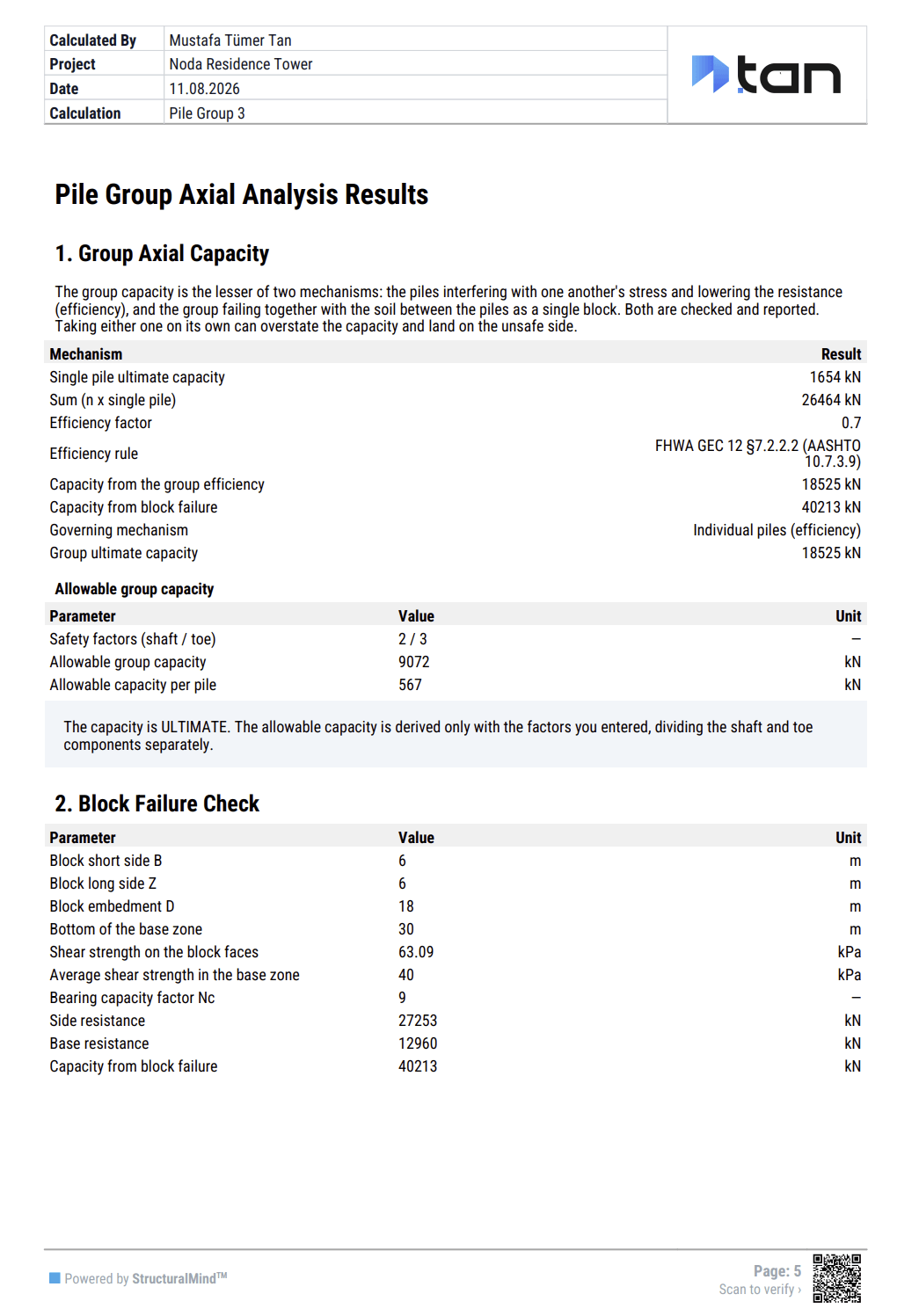
A pile group does not carry 'n' times what a single pile carries. Axially, capacity is the lesser of the efficiency factor and block failure. Laterally, a rigid pile cap forces every pile to the same deflection, so the rows do not share the load equally — a trailing row pushes soil the row ahead of it has already displaced. Both runs work in your browser and are reported with the clause each rule comes from.
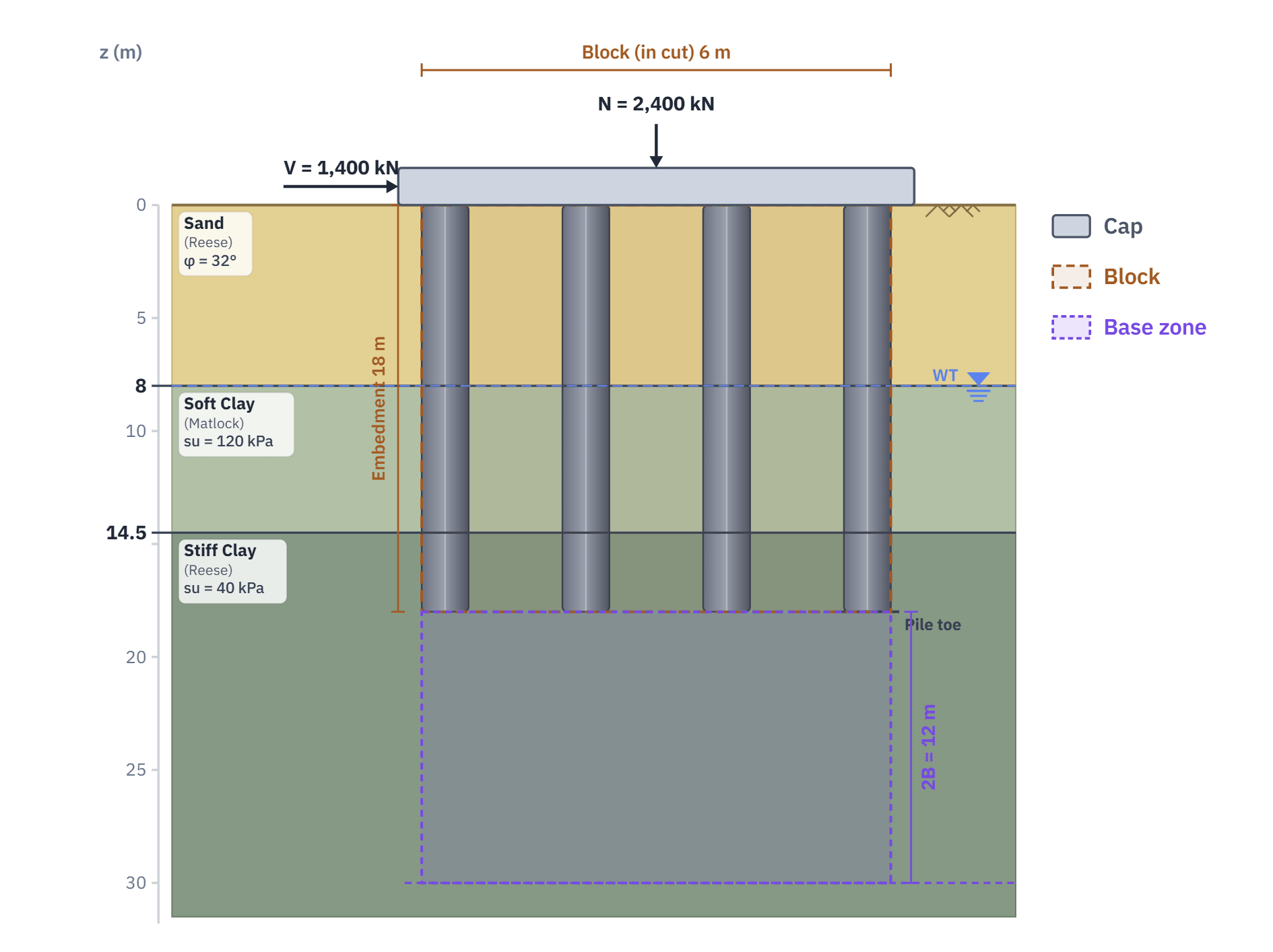
Group layout and load direction
Enter the number of rows and columns, the centre-to-centre spacing in both directions and the load direction. The plan view and 3D array update as you type, and the spacing-to-diameter ratio and load per pile stay visible throughout.
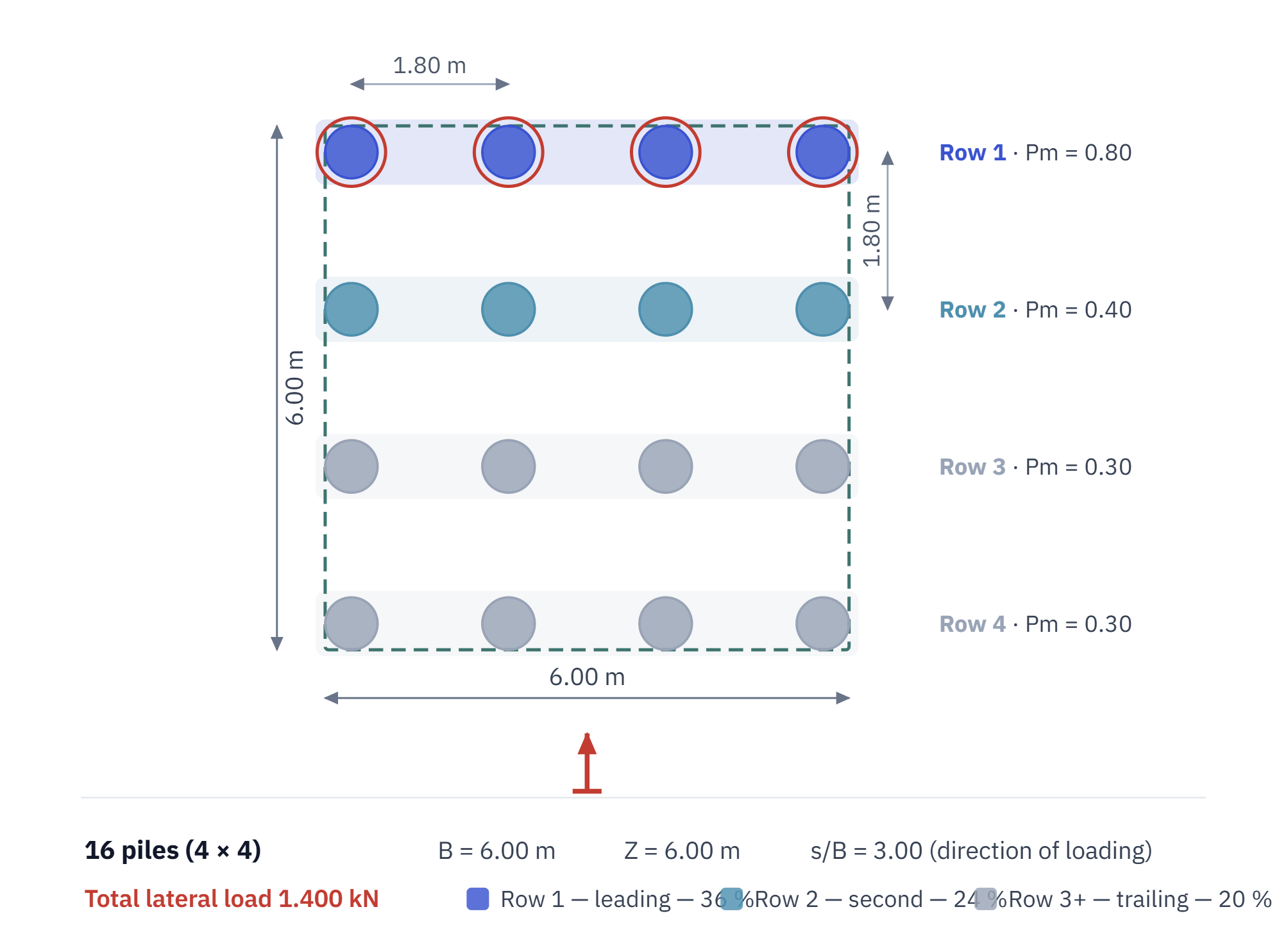
Axial capacity: efficiency and block failure
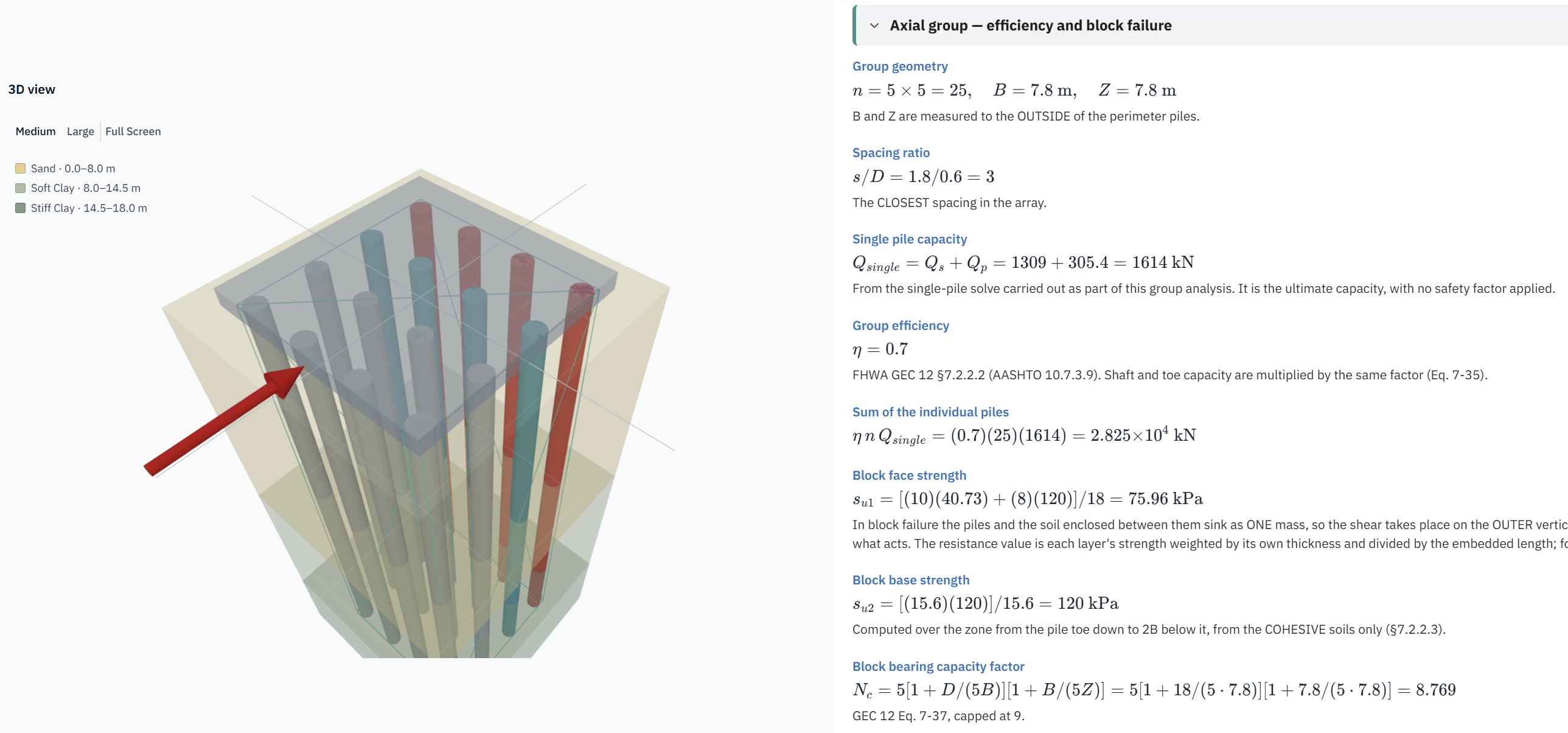
The efficiency factor follows the installation method, the layer that provides most of the resistance and whether the pile cap bears on the soil. In soft clay the group is also checked for failing as a single block, and the lesser of the two governs. The result names the rule that applied.
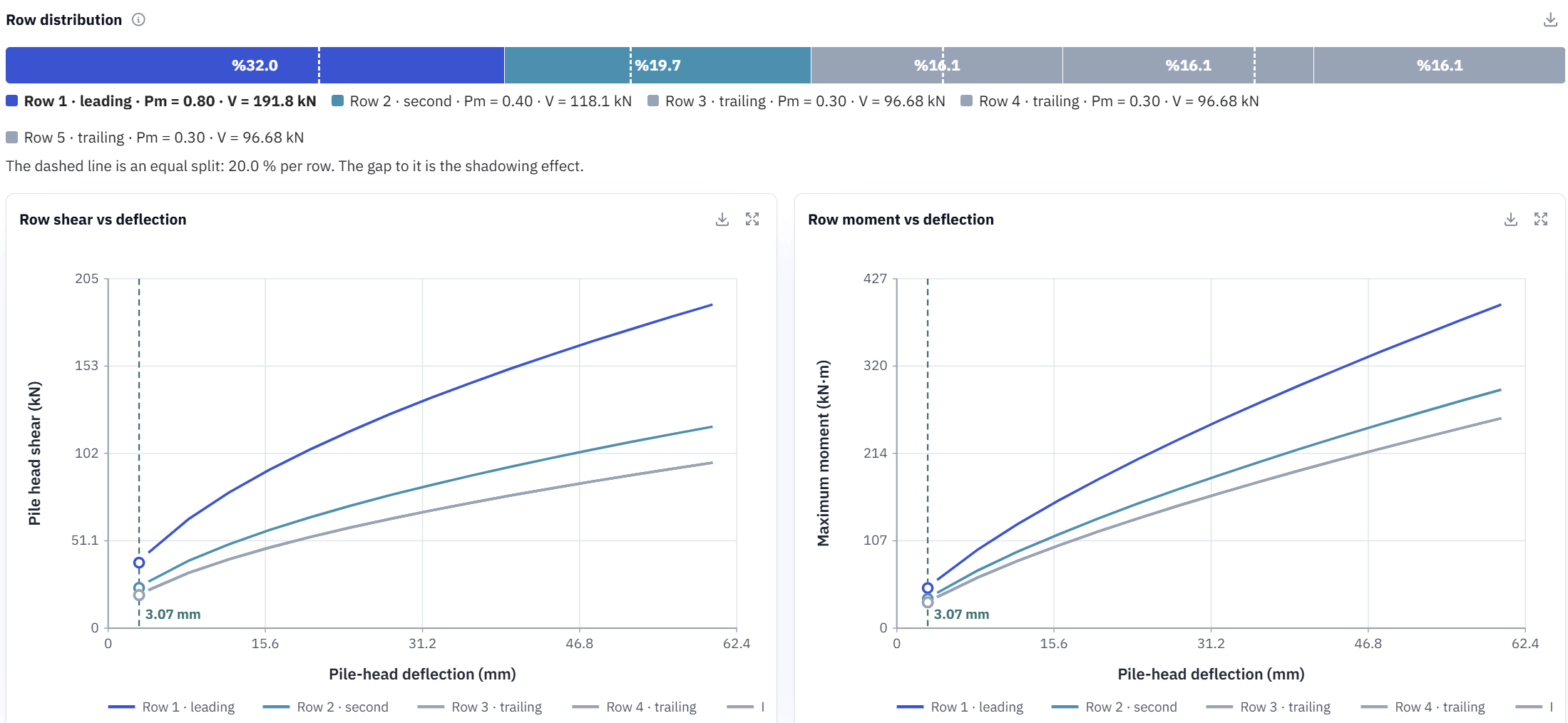
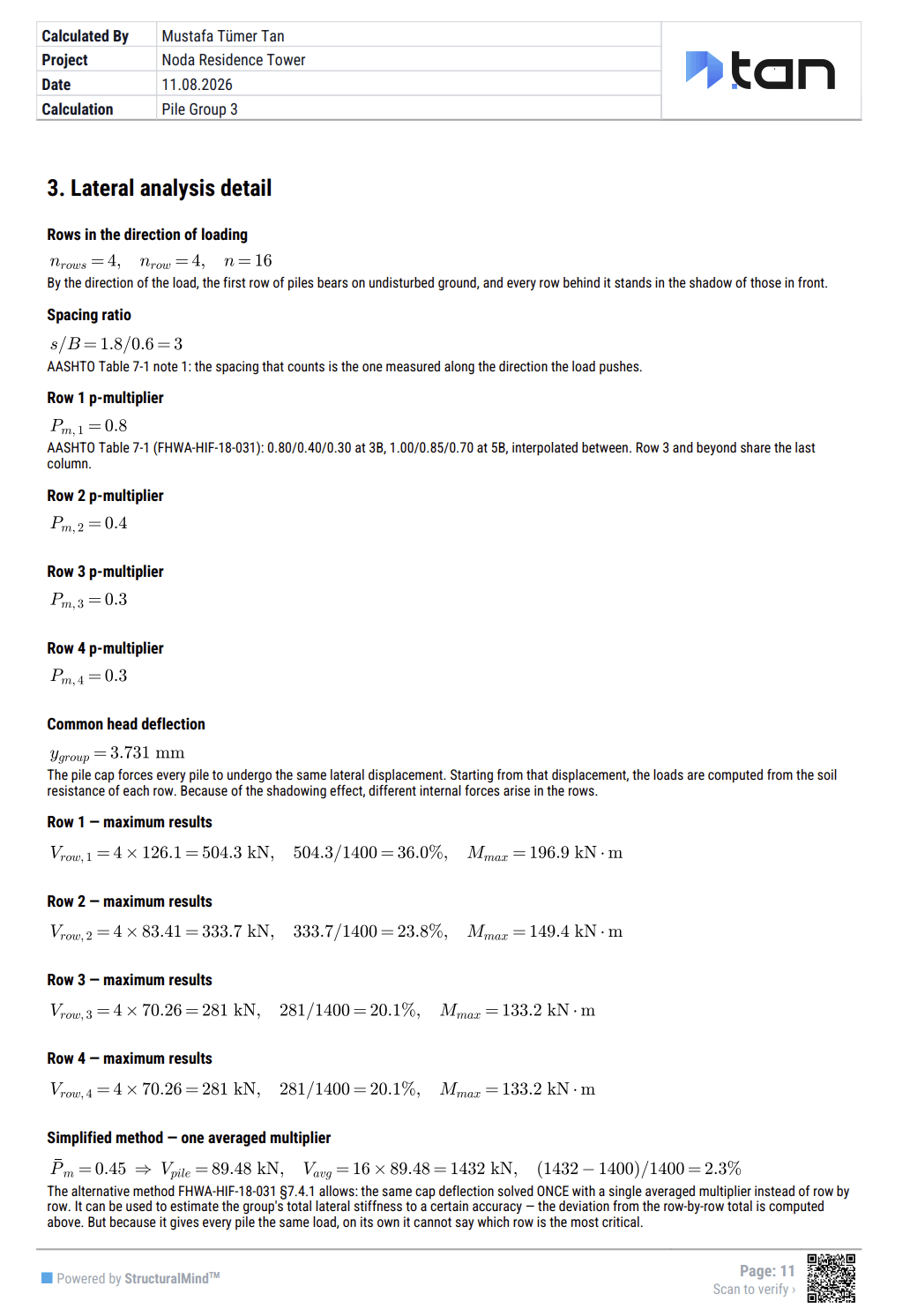
Row-based p-multipliers and load distribution
Each row is solved as a single pile whose p-y curves are scaled by its own multiplier. At the common deflection, the load share, shear and moment of every row come out separately, and the governing moment is read straight off the leading row.
Cross-check against the averaged method
The second published method solves once with an averaged multiplier and adds a spacing-dependent overstress allowance to the moment. The row-based result is reported next to that value, so the difference between the two approaches stays visible.
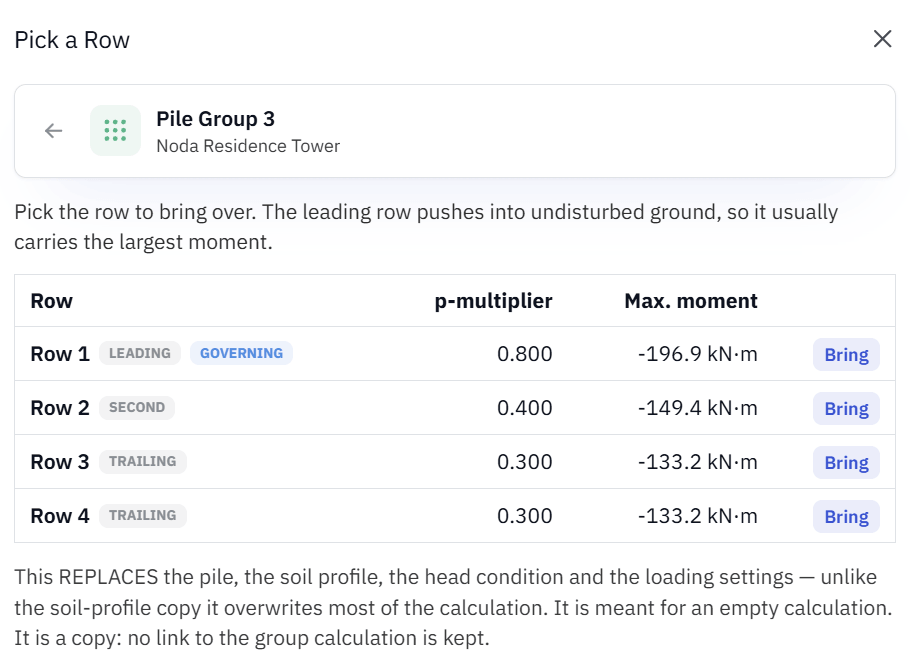
Open a row in the single pile analysis
Any row in the pile group results can be sent to the Single Pile — Axial and Lateral Analysis macro with its p-multiplier and boundary conditions attached, where its moment diagram, p-y curves and step-by-step calculation can be inspected in full.
Clause-referenced report, publishable calculation
The efficiency rule, block failure equation and row multipliers are shown with the clause each one comes from. A calculation can be published as an immutable copy and shared through a QR-coded verification link.
Questions
- How is the efficiency factor chosen?
- When the layer providing most of the resistance is cohesionless, driven piles take 1.0, while bored and CFA piles rise linearly from 0.65 at 2.5 diameters of spacing to 1.0 at 4 diameters. In cohesive soil the undrained shear strength, cap contact and spacing decide together. If you enter your own efficiency factor, the analysis uses it and reports it as a user value.
- When is block failure checked?
- Block failure is checked whenever a cohesive soil is present below the pile toe. The soil profile has to be defined to a depth of twice the short side of the block below the toe. If the profile ends shallower, the result comes back as not applicable and states the depth that has to be reached.
- Is group settlement computed?
- No. The axial side computes capacity. A pile group may settle more than a single pile at the same load per pile, and that effect is outside the scope of this calculation. Everything left out is listed on the documentation page.
- Is this calculation free?
- Pile Group Analysis is a premium calculation included in the Engineer plan. You can try it free.
Start calculating in minutes.
Sign up, pick a calculation, and produce your first auditable report.